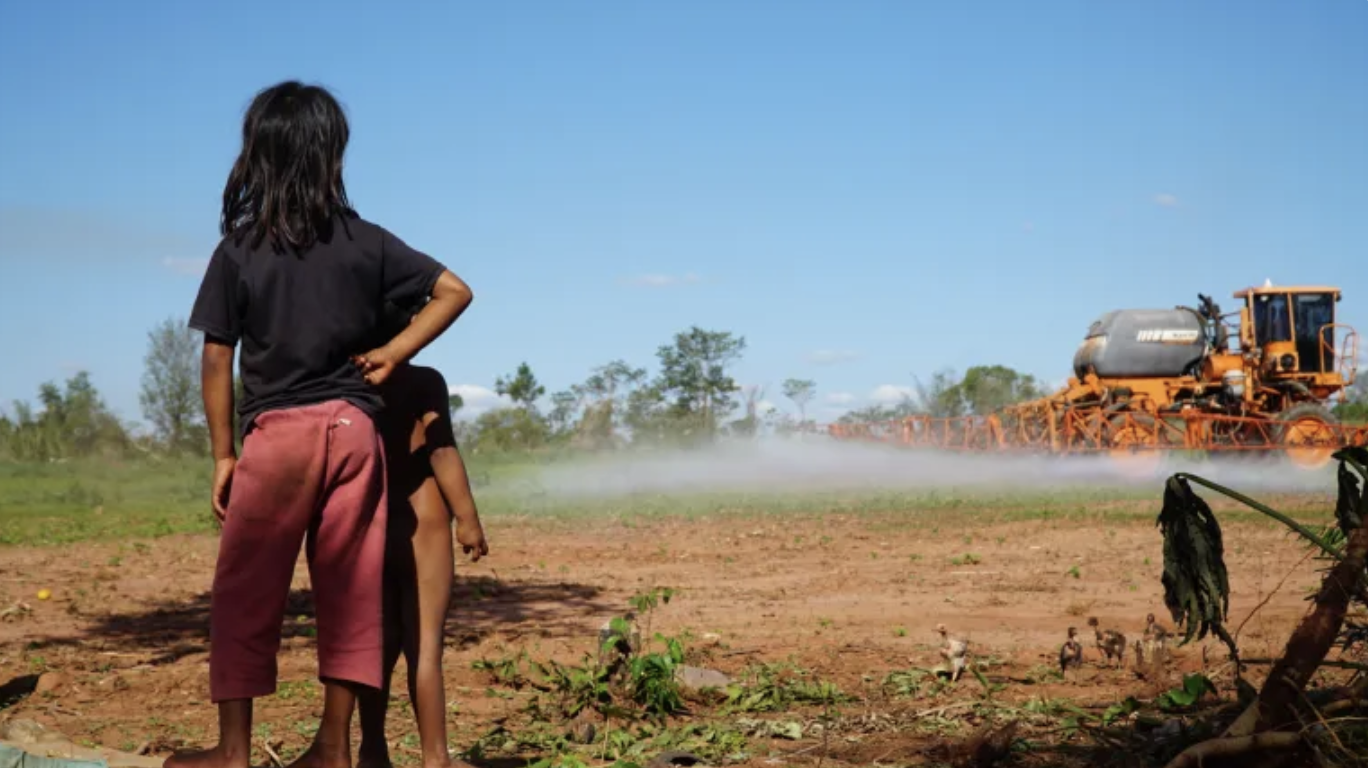
 Ava Guarani children observe a tractor spraying pesticides at the edge of their village, Paraguay (Photo: Neil Giardino/Al Jazeera)ECCHR | 23 June 2026
German authorities ignore human rights violations: corporate greenwashing instead of justice
Following a flawed process, civil society organizations have rejected a mediation offer by the German National Contact Point from the OECD after it dismissed key claims in their complaint against agrochemical giant Bayer. The complaint documents severe human rights and environmental harms linked to Bayer’s glyphosate-based pesticides and genetically modified soy business model in South America – yet once again, the company escapes accountability.
In April 2024, an alliance of six organizations – Centro de Estudios Legales y Sociales (CELS, Argentina), Terra de Direitos (Brazil), BASE-IS (Paraguay), Fundación TIERRA (Bolivia), Misereor, and the European Center for Constitutional and Human Rights (ECCHR) – filed the OECD complaint, a mechanism that allows for national contact points to examine the application of the OECD Guidelines on Multinational Enterprises by companies and to act as a non-judicial grievance mechanisms. The complaint describes serious health impacts, water and food contamination, deforestation, criminalization of community leaders, and land conflicts against local communities in the areas affected by Bayer's agribusiness soy model.
More than two years after the filing of the complaint in April 2024, the German NCP decided to close the case. In its closing statement, it recognizes that Bayer’s products are plausibly linked to the negative impacts described in the complaint, yet ruled out any possibility to discuss the resulting violations of communities’ rights to health, food, land, water, and a healthy environment. On that basis the NCP still offered a mediation between the civil society organizations and the company that focused only on Bayer’s general due diligence policies – neglecting the concrete harms suffered by affected communities.
“We have decided to reject the mediation because discussing abstract policies changes nothing for people who are still losing their land and are getting sick after being exposed to Bayer’s pesticides used in soy production. A mediation on these terms would have allowed Bayer to instrumentalize affected communities for so-called greenwashing while avoiding real improvements in its business practices,” explains Silvia Rojas Castro, Senior Legal Advisor at ECCHR.
“The violations and negative impacts for communities continue unabated. Bayer's due diligence policies have proven demonstrably ineffective, yet the company refuses to acknowledge its responsibility,” says Jaqueline Andrade, Coordinator at Terra de Direitos.
Throughout the complaint process, Bayer repeatedly attempted to contact affected communities outside official channels, circumventing the formal procedure and avoiding accountability under the OECD Guidelines. The complainant organizations made clear that the NCP complaint mechanism was the only appropriate forum for meaningful dialogue. Therefore, it came as a surprise that the NCP called on both parties to engage in informal talks even after the rejection of its insufficient mediation offer. The organizations declined, as such talks would have delivered precisely what Bayer had sought from the outset: a low-stakes, non-binding exchange with no formal accountability.
Urgent need for binding laws
As was the case with the OECD-complaint against Swiss agrochemical company Syngenta, this NCP statement once again highlights the systemic failure of existing so-called “soft law” mechanisms. “Non-binding regulations do not provide communities in the Global South, who are affected by human rights abuses by German companies, with meaningful access to justice,” says Sarah Schneider, expert in agriculture and global food security at Misereor. “Rather than facilitating accountability, the German NCP imposed an unjustifiably high burden of proof on victims – while taking more than a year to deliver a decision that ultimately serves to protect corporate interests over human rights.”
The case underscores the urgent need for binding corporate due diligence laws. UN experts have recently called for stronger regulation of the agribusiness sector to ensure the rights of peasant farmers and indigenous communities. Yet, Germany's Supply Chain Act (LkSG) is currently under attack, and the EU Corporate Sustainability Due Diligence Directive (CSDDD) has been watered down significantly in the European Parliament. The organisations expect an effective implementation of the CSDD in Germany, including laws establishing civil liability mechanisms, comprehensive participation of affected people and independence of the implementing administrative body from government interference.
Notes to editors:
- The complaint was filed in April 2024 documenting four specific cases of health impacts, environmental contamination, and land rights violations. Both the complaint and the response to the German NCP are available here.
- The German NCP took more than two years to publish its final decision, which is available on the NCP’s website.
- Over 50% of agricultural land in Argentina, Brazil, Paraguay and Bolivia is cultivated with GM soybeans resistant to glyphosate. In the region, Bayer acknowledges it has a market share of around 30% for glyphosate-based products.
- OECD-Complaint against Swiss agrochemical company Syngenta
- More information on the case here.
Contact:
ECCHR, Maria Bause, [email protected]
Misereor, Barbara Wiegard, [email protected]