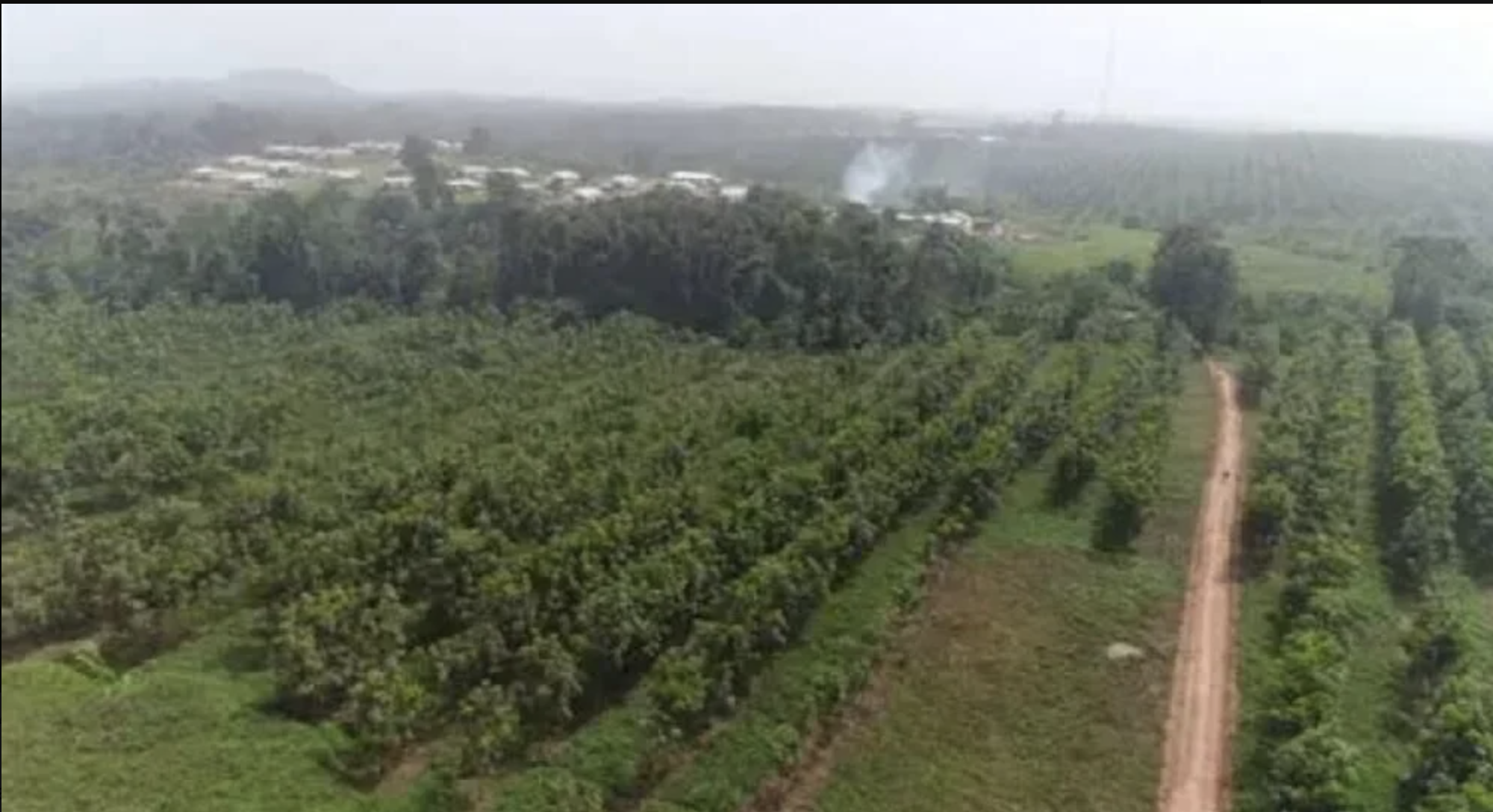
 An aerial view of the Liberian Agricultural Company located in Grand Bassa CountyLiberian Observer | 3 March 2025
Government cracks down on wage violations at LAC
By Claudius T. Greene, Jr.
The government, through the Ministry of Labour (MoL), has ordered two subcontracting firms operating within the Liberian Agriculture Company (LAC) concession to pay thousands of United States dollars in retroactive wages to more than 500 workers, following an investigation that uncovered years of minimum wage violations.
Labour Minister Cooper W. Kruah Sr. announced the enforcement action after a Ministry-led probe confirmed that workers hired through third-party contractors were consistently paid below Liberia’s legally mandated minimum wage.
“This intervention demonstrates that all hiring entities, regardless of contractual arrangements, must comply with the Decent Work Act,” Minister Kruah said at a weekend press briefing in Monrovia. He described the wage disparity as “an unfair labour practice” and warned employers that violations would attract firm government action.
The investigation followed an assessment visit to the LAC concession in Grand Bassa County, where workers complained they were earning below the statutory minimum. Although LAC clarified that the affected workers were employed by independent subcontractors rather than the company itself, the Ministry determined that outsourcing does not exempt employers from compliance with the law.
Under Chapter 5, Section 16.1(a) of Liberia’s Decent Work Act, workers in formal concession areas are entitled to a minimum daily wage of US$5.50. However, investigators found that the workers were being paid US$3.80 per day.
Mr. Arthur Peters, who has supervised 213 workers since 2019, was ordered to pay US$9,414.60 in back wages, while Mr. George B. Vonsuah, overseeing 326 workers since 2022, must pay US$9,705.92. Both were found to have underpaid workers for extended periods.
The Ministry has mandated its Grand Bassa Labour Commissioner to supervise full compliance and ensure timely compensation.
A Pattern in Liberia’s Concession Economy
The LAC case highlights a broader structural challenge within the country’s concession-based economy. Large agricultural, mining, and rubber concessions have historically relied on subcontractors and labor brokers, a practice that can blur accountability.
Over the years, similar labor disputes have emerged at major concession sites. Workers at rubber plantations have staged protests over wages and living conditions, while mining employees have raised concerns about safety standards and contractual irregularities. In some cases, strikes disrupted operations and required government mediation.
Such violations have had tangible consequences for workers. Persistent underpayment reduces household income; limits access to education and healthcare and increases vulnerability to debt. In rural concession communities, where employment options are limited, wage violations can destabilize entire local economies.
A labor advocate noted, “When a worker is underpaid for years, it is not just a legal issue—it becomes a social justice issue. Families plan their lives around wages that never meet the legal threshold.”
Implications for the Labour Sector
The Ministry’s decisive action at LAC sends a clear message that subcontracting arrangements will no longer serve as loopholes for non-compliance.
By publicly naming the offending contractors and enforcing retroactive payments, the government is attempting to reset expectations within the labor sector.
Many believe that the move could strengthen enforcement credibility under the Decent Work Act, encourage workers to report violations, compel concession companies to tighten oversight of contractors, and signal that compliance applies across all tiers of employment.
However, some caution that one high-profile enforcement action must be followed by sustained monitoring to shift systemic behavior.
“The true test will be consistency,” said a former labor inspector. “If similar cases are handled with equal firmness, it could transform labor relations in concession areas.”
The Work Permit Controversy
The enforcement action comes amid ongoing debate surrounding Minister Kruah’s handling of work permits for foreign nationals.
In recent months, sections of the public and some lawmakers have questioned the issuance of work permits to expatriates in sectors where qualified Liberians are believed to be available. Critics argue that excessive or poorly scrutinized permits undermine local employment opportunities, particularly in a country grappling with high youth unemployment.
Minister Kruah has defended the Ministry’s actions, stating that work permits are granted in accordance with the law and are often necessary in specialized technical fields where skills gaps exist. He has emphasized that the Ministry balances investment facilitation with protection of Liberian workers.
The controversy has placed the Ministry under heightened scrutiny, amplifying calls for transparency in both permit issuance and labor law enforcement.
Taken together, the LAC wage enforcement and the work permit debate reflect a broader struggle to define the future of Liberia’s labor market: how to protect local workers while maintaining an investment-friendly environment.
For the more than 500 workers set to receive back pay, the decision provides immediate financial relief and restores a measure of justice. For the labor sector, it could mark a pivotal moment in enforcing standards long criticized as weakly implemented.
If the Ministry sustains its enforcement posture and clarifies work permit policies transparently, Liberia’s labor framework could emerge stronger and more balanced. But if enforcement proves selective or inconsistent, skepticism may persist.
As Minister Kruah put it, “Violations of workers’ rights will not be tolerated.” Whether this declaration signals a sustained reform drive or a singular corrective action will shape the confidence of Liberia’s workforce in the months ahead.